
For generations, the traditional African agricultural model has operated in silos. A smallholder farmer works in isolation to harvest a crop, an independent middleman buys it at a fraction of its value, a distant facility handles the processing, and a fragmented logistics network attempts to transport it to market.
The cost of these disconnected links is steep: staggering post-harvest losses, erratic market pricing, food insecurity, and vast economic value leaking out of the continent.
To feed a rapidly growing population and unlock true economic sovereignty, Africa must move past fragmented agriculture. The future belongs to integrated food systems—deeply connected ecosystems where sourcing, processing, preservation, logistics, and export work in perfect, data-driven harmony.
Here is why a unified approach to food production is the ultimate catalyst for Africa’s economic growth.
1. Seamless Sourcing: Empowering and Stabilizing the Supply Base
An integrated food system begins at the roots. In a disconnected model, processors often struggle with inconsistent raw material supply, while farmers suffer from a lack of predictable market demand.
Integrated ecosystems bridge this gap by creating direct, structural pipelines between local agricultural landscapes and modern processing facilities.
- Predictable Offtake: Farmers are plugged directly into a commercial network, giving them guaranteed buyers, fair pricing, and the financial security to invest back into their land.
- Agronomic Support: Because the processing side relies on high-quality inputs, an integrated system naturally incentivizes the sharing of weather insights, premium seeds, and sustainable farming techniques with smallholders.
When sourcing is streamlined, farming ceases to be a gamble. It becomes a reliable, foundational engine for rural wealth creation.
2. Optimized Production: The Synergy of Proximity
When agricultural processing and production systems are built adjacent to primary sourcing hubs, efficiency skyrockets.
In an integrated ecosystem, raw harvests move instantly from the field into state-of-the-art production lines. This proximity eliminates the heavy long-haul transit of raw, perishable commodities, reducing transportation costs and emissions.
Furthermore, industrializing the production line under a single ecosystem infrastructure allows for rigorous quality control, adherence to global food safety benchmarks, and the agility to quickly adapt to shifting market demands.
3. Closed-Loop Preservation: Defeating the Cold Chain Crisis
Preservation cannot simply be an afterthought; it must be completely embedded into the logistical architecture of the food system.
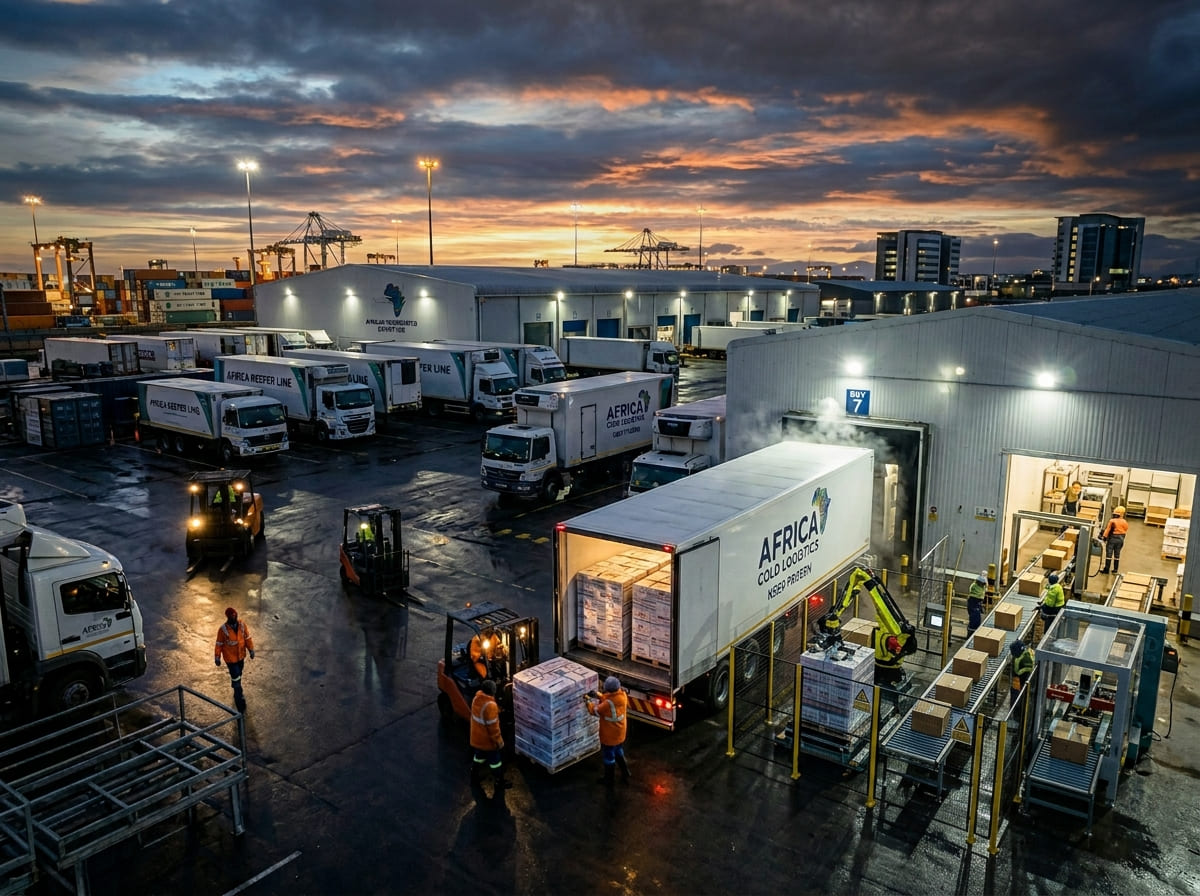
[Farm Harvest] ➔ [Immediate Eco-Processing] ➔ [Continuous Cold Chain Logistics] ➔ [Zero-Waste Retail Market]
An integrated system addresses Africa’s critical preservation gap by embedding climate-smart infrastructure directly into the workflow. Temperature-controlled processing units feed immediately into refrigerated transport fleets (cold chain logistics). By ensuring an unbroken cold chain from the point of harvest to the final export container, the system effectively neutralizes the threat of spoilage, preserving nutrition and capturing peak market value.
4. Intelligent Distribution: Activating Continental and Global Markets
An integrated ecosystem serves as an economic superhighway. Instead of navigating fragmented roadblocks and multi-layered brokerage systems, a unified network coordinates everything internally.
The Power of Frictionless Logistics
With built-in export infrastructure and optimized distribution networks, processed goods can fluidly navigate domestic, regional, and global trade corridors.
| Traditional Fragmented Distribution | Integrated Ecosystem Distribution |
| Multi-layered middlemen inflating final shelf prices | Direct-to-market pipelines maximizing producer margins |
| High vulnerability to transit delays and spoilage | Monitored, temperature-controlled fleet logistics |
| Inability to consistently meet strict export standards | Built-in compliance and international food certifications |
This streamlined flow is particularly vital for maximizing the African Continental Free Trade Area (AfCFTA), allowing high-value, processed African food brands to cross borders with minimal friction.
5. Future-Proof Sustainability: Transforming Waste into Wealth
True sustainability is impossible in a fractured supply chain because no single entity takes responsibility for systemic waste. An integrated food ecosystem, by contrast, views the entire agricultural lifecycle through a circular economy lens.
When the entire value chain is connected, agricultural by-products from the processing phase are no longer discarded as environmental waste. Instead, they are captured and repurposed:
- Organic waste is converted into nutrient-rich bio-fertilizers to replenish the very soils that fed the system.
- Crop residues are transformed into clean biomass energy to help power the agro-processing plants.
This closed-loop system minimizes environmental impact, reduces operational costs, and ensures that the growth generated today does not deplete the resources of tomorrow.
Conclusion: The ENATTA Vision for a Connected Continent
Africa’s macroeconomic transformation cannot be achieved by fixing farms alone, nor by simply building isolated factories. Real progress requires a masterfully engineered ecosystem that welds these elements together.
This systemic unity is exactly what ENATTA represents. By binding sustainable sourcing, localized agro-processing, advanced cold chain logistics, and global export structures into a single, cohesive framework, ENATTA is proving that an integrated food system is more than a logistical triumph—it is the foundation upon which Africa’s future economic resilience will be built.
By connecting every dot from African soil to global dinner plates, we aren’t just securing food; we are securing a wealthy, self-sustaining continent.
How do you see integrated logistics reshaping your local agricultural landscape? Join the conversation in the comments below, or subscribe to the ENATTA blog to track our progress across the continent.